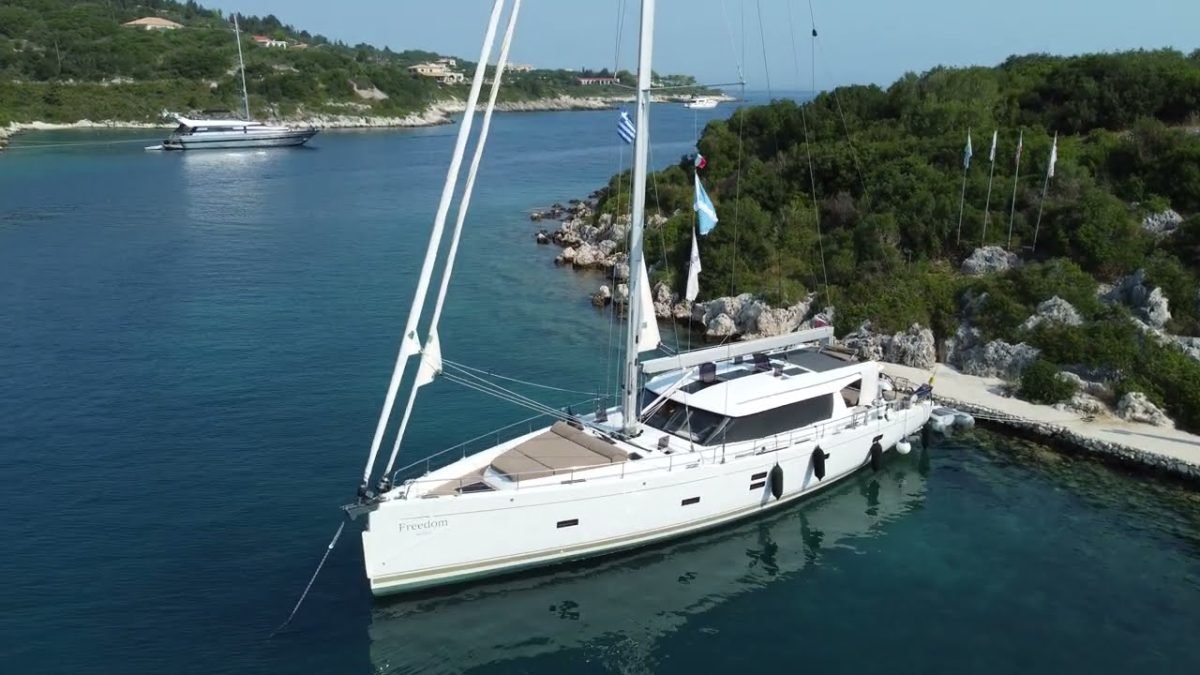
Yacht Freedom loves nothing more than idle exploration around the beautiful Ionian.
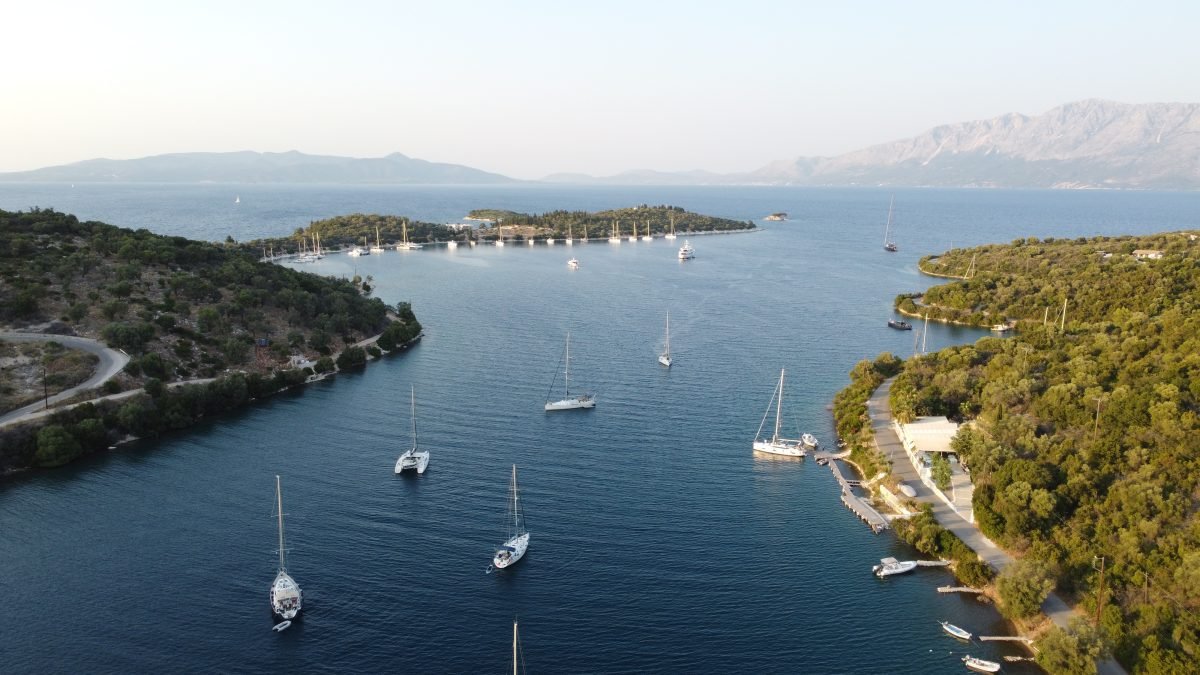
Meganisi is a popular island in the middle of it all and can be busy with loads of boats in the high season. But quieter spots can be found and there’s always anchoring space in Port Atheni. Last time we were there, we went to the café up the hill, and were the only people there – enjoying a delicious supper with a superb view.
The history of this place is pretty special, too. It can be traced back to ancient Greece. The port was once known as Port Artemis, after the Greek goddess of the hunt. It was a popular stop for ships traveling between mainland Greece and the Ionian Islands.
In the 5th century BC, Port Atheni was the site of a battle between the Athenian and Spartan fleets. The Athenians were victorious, and Port Atheni became an important Athenian naval base.
After the fall of the Athenian Empire, Port Atheni remained an important port for trade and commerce. It was also a popular destination for pilgrims, who came to visit the nearby temple of Artemis.
In the Middle Ages, Port Atheni was controlled by the Byzantine Empire. The port was used as a base for Byzantine ships, and was also a center for trade and commerce.
In the 15th century, Port Atheni was captured by the Ottoman Empire. The Ottomans used the port as a base for their warships, and also as a center for trade and commerce.
In the 19th century, Port Atheni was liberated from Ottoman rule. The port became a popular destination for Greek tourists, and is now a major tourist destination.
Now it seems a quiet backwater – odd to think it has such an important and remarkable history. Join us on @yacht.freedom as we explore the Ionian!
@yacht.freedom bobs on the gentle blue waters of the Greek Ionian. From time to time, we rouse ourselves, lift the anchor and sail off to another inlet.
We love to return to Sparkakhori on the island of Meganisi. Not only a protected bay, but after a steep walk up to the top of the hill, a perfect cafe for a brilliant breakfast. Come with us now and we’ll share our delight in the place . . .
We’ve put some aerial videos here: https://oursecretgetaways.com/yacht-freedom-video/
Perched atop a hill overlooking the Ionian Sea like a mischievous cat surveying its domain, lies Spartakhori, a village on the Greek island of Meganisi that’s as charming as it is quirky. Its name, meaning “village of Spartacus” in Greek, hints at its ancient roots, whispering tales of gladiator-turned-rebel Spartacus and his escapades.
As you ascend the winding path that leads to Spartakhori, brace yourself for a visual feast. The azure waters of the Ionian Sea stretch endlessly, dotted with verdant islets, while the rugged contours of neighboring Lefkada Island rise majestically in the distance. Imagine the view from a pirate’s crow’s nest – no wonder they chose this spot for their hideouts.
The village itself is a labyrinth of narrow, cobbled lanes adorned with traditional whitewashed houses. Bougainvillea cascades from balconies in a riot of color, giving the impression that Spartakhori has been doused in a giant paint fight. The air is perfumed with the enticing aromas of freshly baked bread and fragrant herbs wafting from open windows – enough to make your stomach growl louder than a pirate’s parrot.
Spartakhori’s history is as rich as its baklava. Archaeological evidence suggests settlements as early as the 4th century BC, which means this place has seen more drama than a Greek soap opera. Throughout the centuries, it’s been an important outpost for pirates, traders, and even the odd Venetian general.
Despite earthquakes, wars, and economic hardships, Spartakhori has weathered the storms like Odysseus in a particularly perilous seafaring adventure. Its charm has endured, its essence preserved like a jar of ancient olives.
Today, Spartakhori is a living postcard of traditional Greek life, where time seems to slow down and the simple pleasures take precedence. Stroll through the village’s heart, where locals gather at quaint tavernas sharing stories and laughter, the air resonating with the melodies of traditional Greek music. Imagine the scene: men with handlebar mustaches debating politics, grandmothers knitting colorful masterpieces, and children chasing stray cats with unrestrained enthusiasm.
As you wander through Spartakhori’s narrow streets, don’t miss the opportunity to visit the village’s two churches, each a testament to the deep-rooted faith of the community. The Church of Agia Triada, with its iconic blue dome, stands as a landmark, while the Church of Agios Nikolaos, nestled amidst lush greenery, offers a tranquil sanctuary.
Venture beyond the village’s boundaries and explore the surrounding natural wonders. Hike through verdant olive groves, where gnarled branches whisper tales of the past, or descend to the sparkling waters of Spilia Bay, where secluded coves and inviting beaches await. Picture yourself lounging on a sun-drenched beach, the gentle waves lapping at the shore, while the aroma of freshly grilled octopus wafts from a nearby taverna.
Spartakhori is more than just a village; it’s a living museum, a timeless tapestry woven with threads of history, culture, and natural beauty. Its allure lies in its authenticity, its ability to transport you to a bygone era, where life unfolds at a gentler pace, and the simple joys of community and tradition reign supreme. So, come and experience the magic of Spartakhori, where ancient history blends seamlessly with modern-day charm, and a touch of humor sprinkles the air like oregano on a Greek salad.